
Artificial intelligence is changing how businesses manage data, automate operations and make decisions. But are organizations prepared for the security risks that come with AI adoption?
AI security risks for businesses include data leakage, prompt injection, unauthorized access, model manipulation and AI-powered cyberattacks. Without proper security controls, these threats can expose sensitive information and disrupt business operations.
In this article, we explore the most common AI cybersecurity risks, their business impact and practical ways organizations can protect their AI systems. We also explain why AI governance and continuous security monitoring matter.
What Are the Security Risks of AI for Businesses?
AI security risks are vulnerabilities and threats that affect artificial intelligence systems, the data they process and the applications connected to them. Businesses face risks when employees use public AI tools, organizations deploy machine learning models or AI applications connect with internal systems.
Common risks include:
- Sensitive business data exposure.
- Unauthorized access to AI applications.
- Manipulation of AI-generated outputs.
- AI-powered phishing and social engineering.
- Weaknesses in third-party AI platforms.
- Insecure AI integrations and APIs.
These risks can affect organizations of every size, particularly those handling confidential customer, financial and operational information.
7 Common AI Cybersecurity Risks Organizations Should Know
Understanding AI cybersecurity threats helps businesses identify weaknesses before they become serious security incidents.
1. AI Data Leakage
Employees may enter confidential information into public AI platforms to complete everyday tasks. This information could include customer records, financial details, business strategies or source code.
- AI data security becomes a concern when organizations cannot control how information is shared, stored or processed by external AI services.
- Prevention: Establish approved AI usage policies, apply data loss prevention controls and restrict the sharing of confidential information.
2. Prompt Injection Attacks
Prompt injection occurs when attackers create malicious instructions that manipulate an AI model into ignoring its intended instructions. These attacks may cause AI systems to reveal information, produce unsafe outputs or perform unauthorized actions. For example, an AI assistant connected to company documents could be manipulated through malicious content within an uploaded file.
Prevention: Validate inputs, apply security guardrails and restrict AI access to sensitive systems.
3. AI-Powered Phishing Attacks
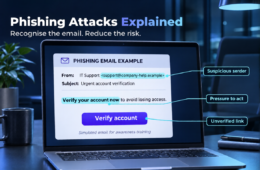
Cybercriminals increasingly use AI to create convincing phishing messages, impersonate executives and generate realistic social engineering content. These attacks can make suspicious emails and communications harder for employees to identify.
Prevention: Conduct regular employee awareness training, strengthen email security and implement multi-factor authentication.
4. Data Poisoning and Model Manipulation
AI systems depend on data to learn, process information and generate results. If attackers manipulate training or fine-tuning data, they may influence model behaviour and reduce its reliability. This creates serious machine learning security threats, particularly when organizations depend on AI for important business decisions.
Prevention: Validate training datasets, monitor data sources and regularly test model performance and integrity.
5. Unauthorized Access to AI Systems
AI applications often connect with business databases, cloud platforms and internal applications. Weak authentication or excessive permissions can allow unauthorized users to access sensitive information. AI agents with unnecessary privileges may also perform actions beyond their intended responsibilities.
Prevention: Apply role-based access controls, multi-factor authentication and least-privilege permissions.
6. Third-Party AI and Supply Chain Risks
Businesses frequently depend on external AI platforms, APIs, software providers and open-source models. A vulnerability in one of these components can affect connected business systems. Third-party integrations may also introduce security weaknesses that organizations cannot easily identify.
Prevention: Assess AI vendors, review security documentation and monitor third-party integrations regularly.
7. AI-Powered Cyberattacks
Attackers can use AI to improve reconnaissance, automate malicious activities and develop more convincing social engineering campaigns. This can increase the speed and scale of cyber threats targeting businesses.
Prevention: Strengthen threat detection, maintain incident response procedures and continuously monitor suspicious activities.
How Do AI Security Risks Impact Businesses?
The consequences of weak Business AI security can extend beyond technical systems.
| Security Risk | Potential Business Impact |
| Data leakage | Exposure of confidential information |
| Prompt injection | Unauthorized AI actions |
| Phishing attacks | Credential theft and account compromise |
| Data poisoning | Unreliable AI decisions |
| Access weaknesses | Unauthorized system access |
| Third-party vulnerabilities | Wider security exposure |
| AI-powered attacks | Increased cyber incident risks |
Organizations in Dubai, Riyadh, the UK and Saudi Arabia should also consider applicable data protection, privacy and cybersecurity requirements when adopting AI technologies.
How Can Businesses Protect Themselves from AI Security Threats?
Managing AI risk for businesses requires a combination of technical controls, employee awareness and effective governance.
Here are practical AI security best practices:
| Security Practice | Why It Matters |
| AI usage policies | Define approved tools and acceptable usage |
| Data protection | Reduce exposure of sensitive information |
| Access management | Prevent unauthorized access |
| AI security testing | Identify weaknesses before deployment |
| Employee training | Reduce human-related security risks |
| Vendor assessments | Identify third-party vulnerabilities |
| Continuous monitoring | Detect suspicious activities |
| Incident response planning | Improve readiness during security incidents |
Businesses should also review AI applications regularly, especially when new features, integrations or automated workflows are introduced.
AI Governance and Compliance – Why Does It Matter?
Security controls alone are not enough to manage enterprise AI risks. Organizations need clear responsibilities, policies and oversight to ensure AI systems are used securely and responsibly.
AI governance and compliance help businesses:
- Define accountability for AI usage.
- Identify and assess AI-related risks.
- Protect personal and business information.
- Review third-party AI providers.
- Maintain appropriate human oversight.
- Support applicable regulatory requirements.
For organizations operating in Dubai, Riyadh, the UK and Saudi Arabia, AI-related data processing should be reviewed against relevant privacy and cybersecurity obligations. A structured governance approach helps organizations balance AI innovation with business security and regulatory responsibilities.
Cyber Awareness – Stay Informed About Emerging Threats
Understanding emerging cyber threats is an important part of protecting business operations. CyberWaze Global shares practical cybersecurity insights through its awareness content and podcast discussions. Explore our Cyber Awareness videos and podcast to learn more about evolving cyber threats, digital protection and security best practices. Watch CyberWaze Cyber Awareness on YouTube
Latest Cybersecurity Insights from CyberWaze
Stay connected with CyberWaze Global for practical updates on cybersecurity, AI-related threats, data protection and enterprise security. Our LinkedIn updates cover emerging security challenges and important developments that organizations should understand. Read our latest updates: CyberWaze Global on LinkedIn

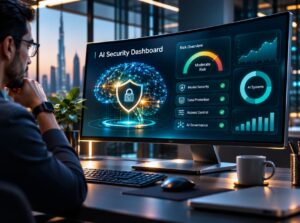
Strengthen Your Business AI Security
AI brings opportunities, but it also creates security risks. Businesses need strong protection, risk management and continuous monitoring. CyberWaze Global helps organizations strengthen security and manage emerging threats. Protect your business with CyberWaze Global. Book a Consultation
Frequently Asked Questions
Q1. What are the biggest AI security risks for businesses?
The most common risks include data leakage, prompt injection, unauthorized access, model manipulation, phishing and third-party vulnerabilities.
Q2. How does generative AI impact business security?
Generative AI can expose confidential information, produce manipulated outputs and create opportunities for attackers to develop convincing phishing campaigns.
Q3. How can businesses prevent AI-related data breaches?
Organizations should use approved AI platforms, apply access restrictions, protect sensitive information and monitor data sharing activities.
Q4. Is AI cybersecurity important for small businesses?
Yes. Small businesses also use AI tools to manage operations, customer information and communications. Security controls help reduce exposure to data breaches and cyberattacks.
Q5. Why is enterprise AI security important?
Enterprise AI security protects business applications, sensitive information and connected systems while helping organizations manage risks associated with AI adoption.